
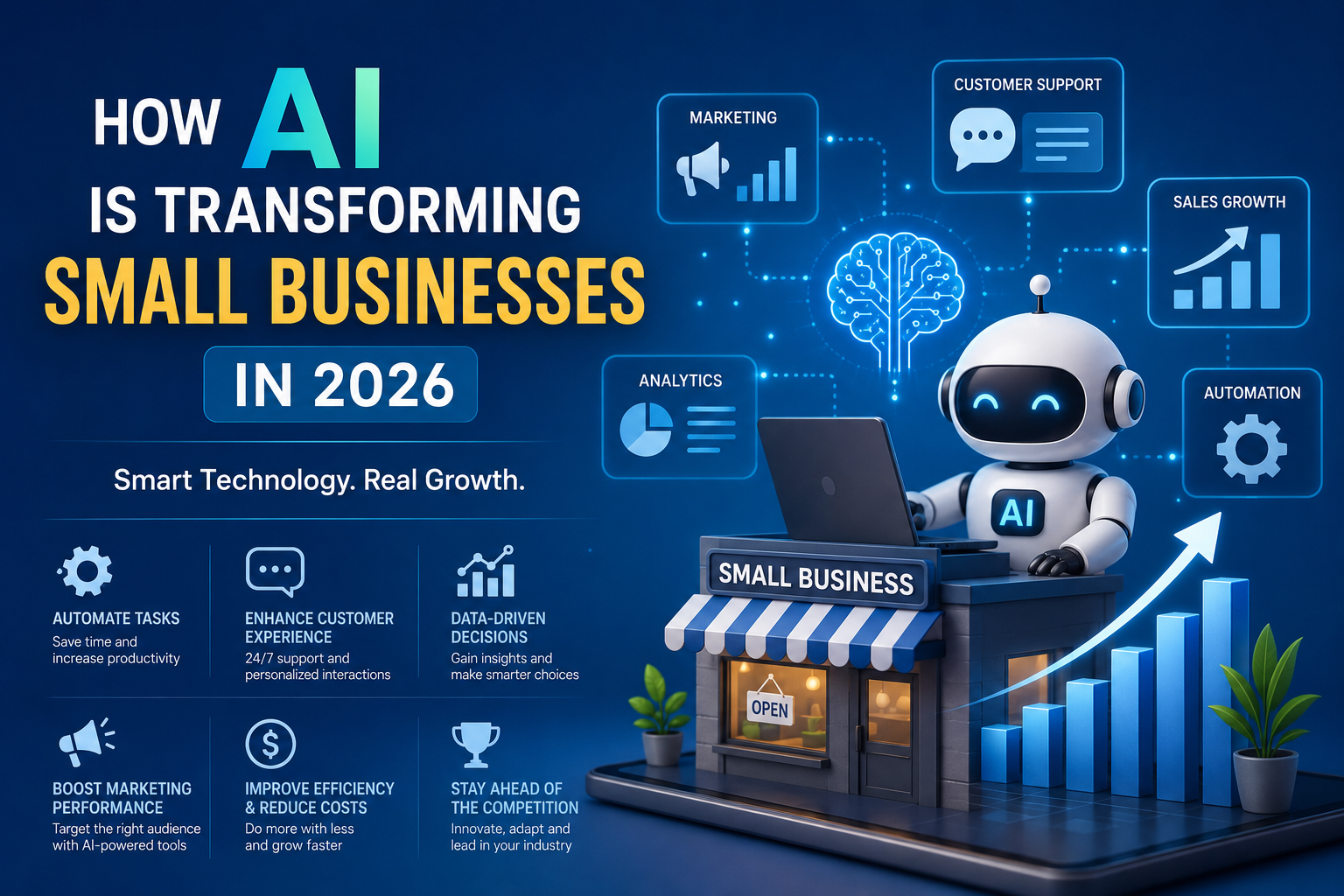
Artificial Intelligence (AI) is no longer a futuristic concept reserved for large corporations with massive budgets. In 2026, AI has become an essential business tool that is helping small businesses compete, grow, and innovate like never before. From automating repetitive tasks to improving customer service and generating valuable business insights, AI is transforming the way small businesses operate.
With the rise of affordable AI tools, cloud-based platforms, and intelligent automation solutions, even startups and local businesses can leverage advanced technologies that were once available only to enterprise organizations. Companies that embrace AI today are experiencing increased productivity, reduced operational costs, better customer engagement, and faster decision-making.
In this article, we’ll explore how AI is transforming small businesses in 2026, the benefits it offers, real-world applications, and why business owners should start investing in AI-powered solutions.
What Is Artificial Intelligence?
Artificial Intelligence refers to computer systems that can perform tasks that normally require human intelligence. These tasks include:
- Learning from data
- Understanding natural language
- Recognizing images and patterns
- Making predictions
- Automating decision-making
- Generating content
Modern AI technologies such as Machine Learning (ML), Natural Language Processing (NLP), Generative AI, and Predictive Analytics are becoming increasingly accessible to small businesses.
Why Small Businesses Are Adopting AI Faster Than Ever
Several factors are driving AI adoption among small businesses in 2026:
Affordable AI Solutions
Cloud-based AI platforms allow businesses to access powerful tools without investing heavily in infrastructure.
Increased Competition
Businesses are using AI to stay competitive by delivering faster services and personalized customer experiences.
Labor Shortages
AI helps businesses automate repetitive tasks, reducing dependence on manual labor.
Better Customer Expectations
Customers expect quick responses, personalized recommendations, and seamless experiences—all of which AI can provide.
1. AI-Powered Customer Support
One of the most significant ways AI is transforming small businesses is through customer service automation.
AI Chatbots
Modern AI chatbots can:
- Answer customer questions instantly
- Handle common support requests
- Process bookings and appointments
- Provide product recommendations
- Operate 24/7
This allows businesses to provide round-the-clock support without hiring additional staff.
Benefits
- Reduced support costs
- Faster response times
- Improved customer satisfaction
- Increased lead conversion rates
For example, an online store can use an AI chatbot to answer product-related questions and guide customers through the purchasing process.
2. Automating Repetitive Business Tasks
Many small businesses waste valuable time on repetitive administrative work.
AI can automate tasks such as:
- Data entry
- Invoice processing
- Email management
- Appointment scheduling
- Inventory updates
- Report generation
By automating these activities, employees can focus on higher-value tasks that contribute directly to business growth.
Business Impact
- Higher productivity
- Fewer human errors
- Faster operations
- Reduced operational costs
Automation is becoming one of the biggest reasons small businesses invest in AI technologies.
3. AI-Driven Marketing and Lead Generation
Marketing has become smarter and more effective thanks to AI.
Personalized Marketing Campaigns
AI analyzes customer behavior and creates personalized experiences based on:
- Purchase history
- Website activity
- Search behavior
- Customer preferences
Content Creation
Generative AI tools can help businesses create:
- Blog posts
- Social media content
- Product descriptions
- Email campaigns
- Marketing copy
Lead Scoring
AI can identify which leads are most likely to convert, allowing sales teams to prioritize high-value prospects.
Results
Businesses using AI-powered marketing often see:
- Higher engagement rates
- Better conversion rates
- Lower advertising costs
- Increased ROI
4. Smarter Financial Management
Managing finances is one of the most challenging aspects of running a small business.
AI-powered financial tools can help with:
Expense Tracking
AI automatically categorizes business expenses and identifies spending trends.
Cash Flow Forecasting
Predictive AI can estimate future cash flow and alert businesses about potential financial risks.
Fraud Detection
AI systems can detect unusual transactions and help prevent financial fraud.
Financial Reporting
Business owners receive real-time reports and actionable insights without manually creating spreadsheets.
This enables smarter financial decisions and improves business stability.
5. Enhanced Sales Performance
Sales teams are increasingly relying on AI to improve results.
AI Sales Assistants
AI tools can:
- Analyze customer interactions
- Suggest next actions
- Generate follow-up emails
- Predict customer purchasing behavior
Predictive Analytics
Businesses can identify which products are likely to sell more and which customers are most likely to make repeat purchases.
Benefits
- Increased sales
- Improved customer retention
- Better forecasting
- More efficient sales processes
Small businesses can now leverage data-driven sales strategies previously available only to large enterprises.
6. Better Decision-Making Through Data Analytics
Data is one of the most valuable business assets in 2026.
AI-powered analytics platforms help businesses understand:
- Customer behavior
- Market trends
- Product performance
- Sales trends
- Operational efficiency
Instead of relying on guesswork, business owners can make decisions based on real-time insights.
Example
A retail store can use AI analytics to determine:
- Which products are selling best
- Which products should be discounted
- Which inventory needs replenishment
This helps maximize profits while reducing waste.
7. Improved Cybersecurity Protection
As businesses become more digital, cybersecurity threats continue to increase.
AI is playing a major role in protecting small businesses from:
- Phishing attacks
- Malware
- Data breaches
- Fraudulent activities
AI Security Systems
Modern AI security tools continuously monitor systems and detect suspicious behavior in real time.
Benefits
- Faster threat detection
- Reduced security risks
- Better compliance
- Enhanced customer trust
For small businesses with limited IT resources, AI-powered cybersecurity solutions provide enterprise-level protection.
8. AI in E-Commerce and Retail
Online retailers are among the biggest beneficiaries of AI technology.
Personalized Shopping Experiences
AI recommends products based on customer preferences and browsing history.
Dynamic Pricing
Businesses can adjust pricing automatically based on demand, competition, and market conditions.
Inventory Management
AI predicts demand and ensures products remain in stock without over-ordering.
Benefits
- Higher sales
- Improved customer experience
- Better inventory control
- Increased profitability
E-commerce businesses that implement AI often gain a significant competitive advantage.
9. Human Resources and Recruitment
Hiring the right employees can be expensive and time-consuming.
AI is streamlining recruitment processes by:
- Screening resumes
- Matching candidates to job requirements
- Scheduling interviews
- Assessing candidate suitability
Employee Management
AI can also help with:
- Employee performance tracking
- Workforce planning
- Training recommendations
This reduces hiring costs and improves workforce efficiency.
10. AI-Powered Business Growth Strategies
AI is helping business owners identify new growth opportunities.
Market Analysis
AI can analyze competitors, industry trends, and customer behavior to uncover opportunities.
Business Forecasting
Predictive models help businesses plan for:
- Seasonal demand
- Revenue growth
- Resource allocation
- Expansion opportunities
Strategic Planning
AI-powered insights allow businesses to make smarter long-term decisions and reduce uncertainty.
Challenges Small Businesses Should Consider
Although AI offers tremendous benefits, businesses should be aware of potential challenges:
Data Privacy Concerns
Businesses must ensure customer data is handled responsibly and complies with regulations.
Employee Training
Teams may need training to effectively use AI-powered tools.
Initial Setup Costs
While AI has become more affordable, implementation may still require investment.
Choosing the Right Tools
Selecting the appropriate AI solutions is essential for achieving positive results.
Despite these challenges, the long-term benefits often outweigh the initial costs.
The Future of AI for Small Businesses
The future looks extremely promising for AI adoption among small businesses.
Emerging trends include:
- AI-powered virtual assistants
- Autonomous business operations
- Hyper-personalized customer experiences
- Voice-enabled business systems
- Advanced predictive analytics
- AI-driven business intelligence
As AI technology continues to evolve, businesses that adopt it early will gain a stronger competitive advantage.
Conclusion
Artificial Intelligence is transforming small businesses in 2026 by making operations more efficient, improving customer experiences, enhancing decision-making, and driving growth. What was once considered advanced enterprise technology is now accessible to businesses of all sizes.
From customer support and marketing automation to cybersecurity and financial management, AI offers countless opportunities for small businesses to increase productivity and profitability.
Organizations that embrace AI today are positioning themselves for long-term success in an increasingly digital and competitive marketplace. Whether you run a startup, retail store, service-based company, or online business, investing in AI-powered solutions is no longer optional—it is becoming a critical part of sustainable business growth.
By adopting the right AI tools and strategies, small businesses can unlock new levels of efficiency, innovation, and customer satisfaction in 2026 and beyond.